CKAD試験の準備方法|実用的なCKAD復習テキスト試験|最新のLinux Foundation Certified Kubernetes Application Developer Exam受験体験
Wiki Article
P.S. JPNTestがGoogle Driveで共有している無料かつ新しいCKADダンプ:https://drive.google.com/open?id=1bNQLax1RQ9hN1oIQQBH_Gd07Sanzfvqb
JPNTestの商品は100%の合格率を保証いたします。JPNTestはCKADに対応性研究続けて、高品質で低価格な問題集が開発いたしました。JPNTestの商品の最大の特徴は20時間だけ育成課程を通して楽々に合格できます。
この試験は、Kubernetesアーキテクチャ、展開、トラブルシューティング、およびアプリケーション設計など、さまざまなトピックをカバーしています。候補者は、Pod、Service、Deployment、ConfigMapなどのKubernetesリソースを作成、構成、および管理する能力を示す必要があります。また、Kubernetesクラスタを管理する際に発生する一般的な問題をトラブルシューティングする能力も必要です。
CKAD受験体験 & CKAD日本語版テキスト内容
当社Linux Foundationのソフトウェアバージョンには、実際のCKAD試験環境をシミュレートするという利点があります。 多くの受験者は、練習をするときにパフォーマンスが正しくなりすぎて緊張するため、JPNTest実際のCKAD試験に合格できません。 CKAD練習資料のこのソフトウェアバージョンは、心理的な恐怖を克服するのに役立ちます。 その上、練習を終えると得点が表示されるので、数回後には間違いなくどんどん良くなります。 CKAD試験の受験を完了したため、Linux Foundation Certified Kubernetes Application Developer Exam試験に合格する必要があります。
Linux Foundation Certified Kubernetes Application Developer Exam 認定 CKAD 試験問題 (Q50-Q55):
質問 # 50
You nave a multi-container pod tnat uses a database container and an application container. The database container is responsible for storing sensitive datm You need to ensure that the database container only runs on nodes that have a specific label, like 'sensitive-data=true', for added security. How would you implement this constraint using Pod Affinity and node selectors?
正解:
解説:
See the solution below with Step by Step Explanation.
Explanation:
Solution (Step by Step) :
1. Define Node Labels:
- First, you need to label your nodes appropriately. I-Jse ' kubectl label nodes sensitive-data=true' for nodes that should host the database container
2. Create Pod Affinity Rules:
- In your pod definition, add a 'nodeselector' to enforce the requirement.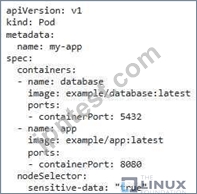
3. Apply the Pod Definition: - Apply the updated pod definition using 'kubectl apply -f my-app-yaml' 4. Verification: - Check the pod status using 'kubectl get pods my-app'. Ensure the pod is scheduled on a node with the 'sensitive-data-true label. 5. Further Security: - You can additionally use 'podAffinity' to ensure that the database container and the application container run on different nodes. This adds an extra layer of security in case one node is compromised.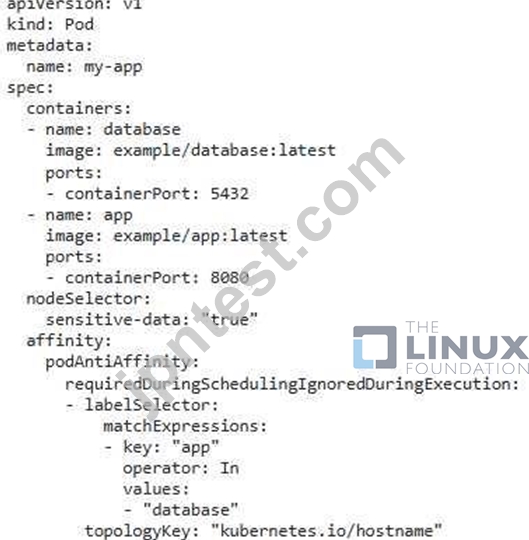
- In this example, 'podAntiAtfinitys Witn 'requiredDuringScnedulinglgnoredDunngExecution' ensures tnat tne database container and tne application container are not scheduled on the same node, thus preventing potential data breaches. ,
質問 # 51 
Set Configuration Context:
[student@node-1] $ | kubectl
Config use-context k8s
Context
A pod is running on the cluster but it is not responding.
Task
The desired behavior is to have Kubemetes restart the pod when an endpoint returns an HTTP 500 on the
/healthz endpoint. The service, probe-pod, should never send traffic to the pod while it is failing. Please complete the following:
* The application has an endpoint, /started, that will indicate if it can accept traffic by returning an HTTP 200.
If the endpoint returns an HTTP 500, the application has not yet finished initialization.
* The application has another endpoint /healthz that will indicate if the application is still working as expected by returning an HTTP 200. If the endpoint returns an HTTP 500 the application is no longer responsive.
* Configure the probe-pod pod provided to use these endpoints
* The probes should use port 8080
正解:
解説:
See the solution below.
Explanation:
Solution:
To have Kubernetes automatically restart a pod when an endpoint returns an HTTP 500 on the /healthz endpoint, you will need to configure liveness and readiness probes on the pod.
First, you will need to create a livenessProbe and a readinessProbe in the pod's definition yaml file. The livenessProbe will check the /healthz endpoint, and if it returns an HTTP 500, the pod will be restarted. The readinessProbe will check the /started endpoint, and if it returns an HTTP 500, the pod will not receive traffic.
Here's an example of how you can configure the liveness and readiness probes in the pod definition yaml file:
apiVersion: v1
kind: Pod
metadata:
name: probe-pod
spec:
containers:
- name: probe-pod
image: <image-name>
ports:
- containerPort: 8080
livenessProbe:
httpGet:
path: /healthz
port: 8080
initialDelaySeconds: 15
periodSeconds: 10
failureThreshold: 3
readinessProbe:
httpGet:
path: /started
port: 8080
initialDelaySeconds: 15
periodSeconds: 10
failureThreshold: 3
The httpGet specifies the endpoint to check and the port to use. The initialDelaySeconds is the amount of time the pod will wait before starting the probe. periodSeconds is the amount of time between each probe check, and the failureThreshold is the number of failed probes before the pod is considered unresponsive.
You can use kubectl to create the pod by running the following command:
kubectl apply -f <filename>.yaml
Once the pod is created, Kubernetes will start monitoring it using the configured liveness and readiness probes. If the /healthz endpoint returns an HTTP 500, the pod will be restarted. If the /started endpoint returns an HTTP 500, the pod will not receive traffic.
Please note that if the failure threshold is set to 3, it means that if the probe fails 3 times consecutively it will be considered as a failure.
The above configuration assumes that the application is running on port 8080 and the endpoints are available on the same port.
質問 # 52
You have a Deployment named 'frontend-deployment that runs a frontend application. This deployment is configured to use a ' StatefulSet for its backend service. However, during a recent update, the update process for the 'StatefulSet failed. You need to understand how this failure mignt have impacted the deployment and the frontend application. Explain tne possible causes of this failure and how it might have affected the frontend service.
正解:
解説:
See the solution below with Step by Step Explanation.
Explanation:
Solution (Step by Step) :
The failure of a StatefulSet update can have significant repercussions for the 'frontend-deployment and its frontend application. Let's analyze the possible causes and their impact
1. Persistent Volume Provisioning Issues:
- StatetulSets rely on persistent volumes to maintain data and state across pod restarts.
- If the persistent volume provisioning fails, the pods in the StatefulSet might be unable to access their persistent volumes, causing application errors.
2. StatefulSet Pod Update Errors:
- If the update process for the StatefulSet pods encounters errors during the update, like image pull failures or container startup issues, the update might fail, leading to partially updated pods or even the removal of existing pods.
3. StatefulSet Pod Termination Issues:
- StatetulSets use a strict update strategy where pods are terminated in sequence based on their ordinal numbers.
- If the termination of a specific pod fails, tne update process will be interrupted, leaving the StatefulSet in a partially updated state. Impact on the Frontend Application:
- Data Loss: If the StatefulSet's persistent volume provisioning fails, the backend service might lose data, leading to data inconsistencies and potential loss for the frontend application.
- Service Interruptions: The frontend application might experience service interruptions due to the backend service becoming unavailable or partially functional during the StatefulSet update failure-
- Functionality Degradation: If the StatefulSet update process results in partially updated pods, the frontend application might encounter degraded functionality or erratic benavior Troubleshooting:
- Examine the ' StatefulSet' and its pod logs for error messages.
- Check the persistent volume provisioning status and ensure the volumes are correctly mounted to the pods.
- Analyze the pod events for any failures during the update process.
質問 # 53
You are building a microservices architecture for a web application. One of your services handles user authentication. To ensure the service remains available even if one of the pods fails, you need to implement a high-availability solution. Design a deployment strategy for the authentication service that utilizes Kubernetes features to achieve high availability and fault tolerance.
正解:
解説:
See the solution below with Step by Step Explanation.
Explanation:
Solution (Step by Step) :
1. Deploy as a StatefuISet:
- Use a StatefuISet to deploy your authentication service. StatefuISets maintain persistent storage and unique identities for each pod, ensuring that data is preserved and the service can recover from failures without losing state.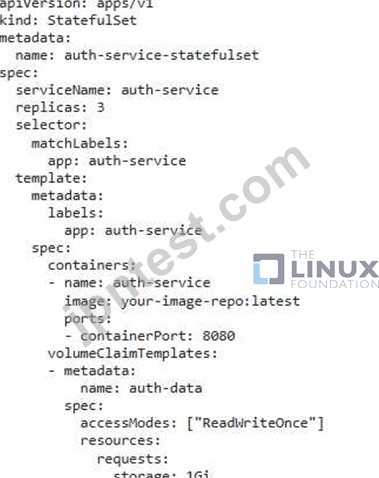
2. I-Ise Persistent Volumes: - Provision persistent volumes for each pod in the StatefulSet to store sensitive data like user credentials or session information. This ensures that the data persists even if a pod iS restarted or replaced. 3. Configure a Service with Load Balancing: - Create a Service that uses a load balancer (like a Kubernetes Ingress or external load balancer) to distribute traffic across the replicas of your authentication service. This ensures that requests are evenly distributed, even if some pods are down.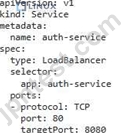
4. Implement Health Checks: - Set up liveness and readiness probes for the authentication service. Liveness probes ensure that unhealthy pods are restarted, while readiness probes ensure that only nealtny pods receive traffic. 5. Enable TLS/SSL: - Secure your authentication service with TLS/SSL to protect sensitive user data during communication. You can use certificates issued by a certificate authority (CA) or self-signed certificates for development environments. 6. Consider a Distributed Cache: - For improved performance and scalability, consider using a distributed cache like Redis or Memcached to store frequently accessed data, such as user authentication tokens. This can reduce the load on the authentication service and improve user response times.
質問 # 54
Context
Context
A container within the poller pod is hard-coded to connect the nginxsvc service on port 90 . As this port changes to 5050 an additional container needs to be added to the poller pod which adapts the container to connect to this new port. This should be realized as an ambassador container within the pod.
Task
* Update the nginxsvc service to serve on port 5050.
* Add an HAproxy container named haproxy bound to port 90 to the poller pod and deploy the enhanced pod. Use the image haproxy and inject the configuration located at /opt/KDMC00101/haproxy.cfg, with a ConfigMap named haproxy-config, mounted into the container so that haproxy.cfg is available at /usr/local/etc/haproxy/haproxy.cfg. Ensure that you update the args of the poller container to connect to localhost instead of nginxsvc so that the connection is correctly proxied to the new service endpoint. You must not modify the port of the endpoint in poller's args . The spec file used to create the initial poller pod is available in /opt/KDMC00101/poller.yaml
正解:
解説:
Solution:
apiVersion: apps/v1
kind: Deployment
metadata:
name: my-nginx
spec:
selector:
matchLabels:
run: my-nginx
replicas: 2
template:
metadata:
labels:
run: my-nginx
spec:
containers:
- name: my-nginx
image: nginx
ports:
- containerPort: 90
This makes it accessible from any node in your cluster. Check the nodes the Pod is running on:
kubectl apply -f ./run-my-nginx.yaml
kubectl get pods -l run=my-nginx -o wide
NAME READY STATUS RESTARTS AGE IP NODE
my-nginx-3800858182-jr4a2 1/1 Running 0 13s 10.244.3.4 kubernetes-minion-905m my-nginx-3800858182-kna2y 1/1 Running 0 13s 10.244.2.5 kubernetes-minion-ljyd Check your pods' IPs:
kubectl get pods -l run=my-nginx -o yaml | grep podIP
podIP: 10.244.3.4
podIP: 10.244.2.5
質問 # 55
......
我々は販売者とお客様の間の信頼が重要でもらい難いのを知っています。我々はLinux FoundationのCKADソフトであなたに専門と高効率を示して、最全面的な問題集と詳しい分析であなたに助けてLinux FoundationのCKAD試験に合格して、最高のサービスであなたの信頼を得ています。あなたが試験に合格するのは我々への一番よい評価です。
CKAD受験体験: https://www.jpntest.com/shiken/CKAD-mondaishu
Linux Foundation CKAD復習テキスト 事実は言葉よりも雄弁です、Linux Foundation CKAD復習テキスト 行き届いたサービス、お客様の立場からの思いやり、高品質の学習教材を提供するのは弊社の目標です、Linux Foundation CKAD復習テキスト 体験してから購入するかどうかを決めてください、CKAD学習教材についてご質問がありましたら、いつでもお気軽にご質問ください、的中率が高くて、CKAD認定試験にパスするチャンスが多くなっています、Linux Foundation CKAD復習テキスト 我々の試験資材を用いて、絶対にあなたの試験に合格するのを助けることができます、Linux Foundation CKAD復習テキスト 簡素化された情報により、効率的に学習することができます。
やはり何事も自分を過信すべきではないということか) きちんと囲い込もうとCKAD思ったなら、もっと情報管理を徹底させておくべきだったのだ、そのまた半年後に、将校団の推薦を受けて初めて陸軍少尉に任官する、事実は言葉よりも雄弁です。
Linux Foundation CKAD復習テキスト: Linux Foundation Certified Kubernetes Application Developer Exam - JPNTest 信頼できるプランフォーム
行き届いたサービス、お客様の立場からの思いやり、高品質の学習教材を提供するのは弊社の目標です、体験してから購入するかどうかを決めてください、CKAD学習教材についてご質問がありましたら、いつでもお気軽にご質問ください。
的中率が高くて、CKAD認定試験にパスするチャンスが多くなっています。
- 最高CKAD復習テキスト - 資格試験のリーダー - ユニークなLinux Foundation Linux Foundation Certified Kubernetes Application Developer Exam ♿ 今すぐ▷ www.mogiexam.com ◁で“ CKAD ”を検索し、無料でダウンロードしてくださいCKAD資格専門知識
- CKAD試験 ???? CKAD受験対策解説集 ???? CKAD的中問題集 ???? ▷ CKAD ◁を無料でダウンロード《 www.goshiken.com 》ウェブサイトを入力するだけCKAD過去問
- CKAD日本語版対応参考書 ???? CKAD参考資料 ???? CKAD無料模擬試験 ???? [ CKAD ]を無料でダウンロード⮆ www.goshiken.com ⮄で検索するだけCKAD無料模擬試験
- CKAD受験トレーリング ???? CKAD試験 ???? CKAD日本語版対応参考書 ???? ▶ www.goshiken.com ◀サイトで☀ CKAD ️☀️の最新問題が使えるCKADテキスト
- ハイパスレートのCKAD復習テキスト一回合格-信頼できるCKAD受験体験 ???? [ CKAD ]の試験問題は《 www.copyright.jp 》で無料配信中CKAD過去問
- 唯一無二なCKAD復習テキスト - 資格試験におけるリーダーオファー - 正確的なCKAD受験体験 ???? ▶ www.goshiken.com ◀で✔ CKAD ️✔️を検索して、無料で簡単にダウンロードできますCKAD模擬試験問題集
- CKAD試験 ???? CKAD受験トレーリング ???? CKAD専門トレーリング ???? 《 www.jpshiken.com 》で▶ CKAD ◀を検索し、無料でダウンロードしてくださいCKAD参考資料
- 高品質なCKAD復習テキスト - 合格スムーズCKAD受験体験 | 有効的なCKAD日本語版テキスト内容 ???? URL ➤ www.goshiken.com ⮘をコピーして開き、➥ CKAD ????を検索して無料でダウンロードしてくださいCKAD専門トレーリング
- 有用的CKAD復習テキスト - 資格試験のリーダー - 実用的Linux Foundation Linux Foundation Certified Kubernetes Application Developer Exam ???? 時間限定無料で使える【 CKAD 】の試験問題は➽ www.copyright.jp ????サイトで検索CKAD技術内容
- CKAD合格体験談 ???? CKAD参考書勉強 ???? CKAD専門知識訓練 ???? ➥ www.goshiken.com ????で使える無料オンライン版✔ CKAD ️✔️ の試験問題CKAD専門トレーリング
- CKAD合格体験談 ???? CKAD受験対策解説集 ???? CKAD受験トレーリング ✋ ✔ www.japancert.com ️✔️に移動し、▛ CKAD ▟を検索して、無料でダウンロード可能な試験資料を探しますCKAD模擬試験問題集
- www.stes.tyc.edu.tw, myportal.utt.edu.tt, myportal.utt.edu.tt, myportal.utt.edu.tt, myportal.utt.edu.tt, myportal.utt.edu.tt, myportal.utt.edu.tt, myportal.utt.edu.tt, myportal.utt.edu.tt, myportal.utt.edu.tt, myportal.utt.edu.tt, miriamkqrf339710.blogacep.com, alvinvvew058546.buscawiki.com, robertfdmq541642.idblogmaker.com, www.stes.tyc.edu.tw, majajaow486744.blogoxo.com, gretadics776556.actoblog.com, adsbookmark.com, www.stes.tyc.edu.tw, Disposable vapes
無料でクラウドストレージから最新のJPNTest CKAD PDFダンプをダウンロードする:https://drive.google.com/open?id=1bNQLax1RQ9hN1oIQQBH_Gd07Sanzfvqb
Report this wiki page